What Is Wrapped Bitcoin?
Wrapped Bitcoin (WBTC) is a token that represents Bitcoin on another blockchain so BTC-linked value can be used in applications that do not natively understand Bitcoin transactions. Native Bitcoin came first, and the historical bitcoin launch date helps separate the origin of BTC from the much later idea of wrapping it for other networks. The best-known WBTC system began as an ERC-20 token on Ethereum, using Bitcoin held in custody to back the issued tokens on a one-to-one basis.
Bitcoin and Ethereum are separate systems. Native BTC cannot simply be pasted into an Ethereum smart contract. WBTC solves that compatibility problem by keeping BTC in a custody system while issuing a corresponding token that applications on a supported network can recognize. When the wrapped token is redeemed, WBTC is removed from circulation and the corresponding BTC can be released.

Why does wrapped Bitcoin exist?
WBTC exists because blockchains do not automatically share assets, transaction rules, or smart-contract standards. Bitcoin was designed as its own peer-to-peer electronic cash system, while Ethereum later developed a general-purpose smart-contract environment. A Bitcoin transaction is valid according to Bitcoin’s rules; that does not make the same transaction a native Ethereum asset.
Ethereum applications commonly work with standardized fungible tokens. The ERC-20 token standard defines a reusable interface for transfers, balances, approvals, and supply. By representing BTC value through an ERC-20-compatible token, WBTC can be handled by wallets, decentralized exchanges, lending markets, and other applications built around that standard.
This does not “move” a Bitcoin from the Bitcoin blockchain into Ethereum in a literal sense. The original asset and the representation live in different systems. The wrapper is an accounting and custody mechanism that links the two: BTC is held on one side, while a corresponding token is issued on the other.
That distinction matters because the convenience is real, but so are the additional assumptions. Native BTC ownership depends on control of Bitcoin keys and the Bitcoin network’s settlement rules. WBTC adds custodial, contractual, governance, liquidity, and smart-contract layers. The result can be useful, but it is not technically identical to holding native bitcoin.
How does WBTC work?
The classic WBTC model separates several jobs rather than allowing any user to create tokens at will. A merchant or provider handles the user-facing conversion process, a custodian holds the backing BTC, and the token system controls minting and burning. The exact operational route available to an individual can vary by provider, but the underlying accounting idea is straightforward.
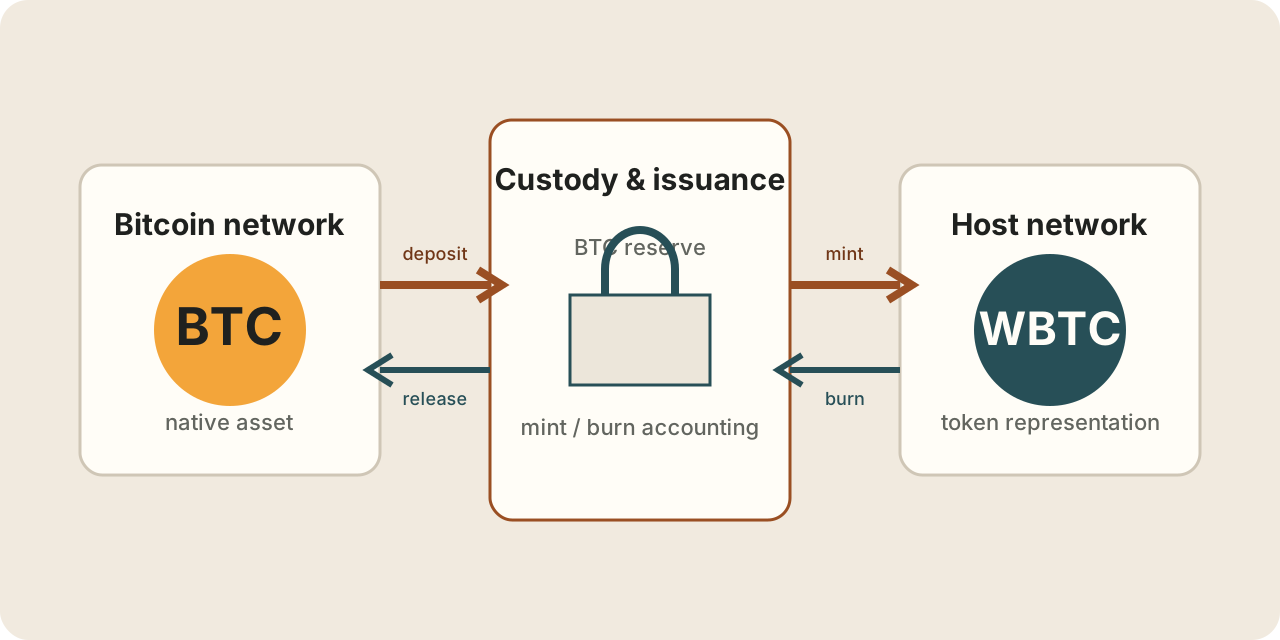
The official WBTC site describes WBTC as backed 1:1 by Bitcoin in custody and provides network, provider, and reserve information. That backing relationship is the economic foundation of the wrapper: if one unit of the token is intended to represent one BTC, users need a credible way to verify that the corresponding reserve exists and that redemption remains operational.
Minting increases the wrapped supply only when the issuance process is satisfied. Burning does the reverse. It removes wrapped units from circulating supply when they are redeemed. This structure is why “wrapped” does not simply mean “a token whose price happens to follow Bitcoin.” The representation is intended to be connected to actual BTC reserves and a defined issuance/redemption process.
On-chain transparency can make parts of the system observable, but observation is not the same thing as eliminating trust. A reserve address can show coins at an address. It does not by itself answer every legal, operational, key-management, counterparty, or redemption question. For that reason, proof of reserves should be read as evidence about one part of the system rather than a universal safety certificate.
WBTC vs Bitcoin: what actually changes?
The easiest way to understand WBTC is to compare what remains similar with what changes. The intended economic exposure is linked to BTC, but the asset you hold, the network you use, and the risks you accept are different.
| Feature | Native Bitcoin (BTC) | Wrapped Bitcoin (WBTC) |
|---|---|---|
| Asset location | Bitcoin network | Token contract on a supported non-Bitcoin network |
| Core unit | BTC | Token representing BTC value |
| Primary settlement rules | Bitcoin protocol and miners | Rules of the host network plus the WBTC token/custody system |
| Smart-contract compatibility | Bitcoin-native scripting and applications | Designed for broader token-based smart-contract applications on supported networks |
| Backing requirement | No external reserve; BTC is the native asset | Designed around corresponding BTC reserves |
| Additional counterparty layer | No wrapper custodian required for self-custodied BTC | Yes, the wrapped system introduces custody and operational dependencies |
| Typical reason to hold | Native Bitcoin ownership and settlement | Use BTC-linked value in applications that require another token standard |
Bitcoin and WBTC have different origins
WBTC is a later interoperability layer built around an asset that already had its own network and history. The important conceptual point is that WBTC did not create Bitcoin or replace the Bitcoin blockchain; it arrived much later as a representation designed for compatibility with other networks.
The Bitcoin white paper describes the original peer-to-peer electronic cash design. WBTC arrived much later. A January 31, 2019 launch announcement from Kyber Network, one of the initiative’s original participants, states that WBTC had gone live on Ethereum as an ERC-20 token backed by BTC.
That chronology helps prevent a common misunderstanding. WBTC is not “Bitcoin 2.0,” a Bitcoin fork, or a new consensus layer for Bitcoin. It is a separate tokenization system that references Bitcoin as the backing asset. If the wrapper disappeared, native BTC and the Bitcoin network would continue to exist independently.

What can Wrapped Bitcoin be used for?
WBTC is useful when a user wants Bitcoin-linked value inside a smart-contract ecosystem whose applications expect compatible tokens. The exact applications available change over time, so it is better to think in categories than to treat a list of named protocols as permanent.
Other uses can include derivatives, structured products, payment flows, or cross-application settlement on supported networks. None of these uses automatically makes WBTC a better asset than BTC. They solve a compatibility problem. Whether the extra functionality is worth the extra layers depends on what the user is trying to do.
For a holder who only wants long-term native Bitcoin custody and does not need a smart-contract application, wrapping may add complexity without adding a necessary capability. For a user who specifically needs BTC-linked collateral in an application that only accepts a compatible token, the wrapper can be functional infrastructure rather than a speculative novelty.
How is WBTC's 1:1 backing supposed to work?
The phrase “1:1 backed” means that the system is designed so each WBTC in circulation corresponds to Bitcoin held in reserve. This is different from an algorithmic peg that attempts to manage price through incentives without holding the represented asset in full reserve.
There are two separate questions to ask. First: does the reserve exist? Public blockchain addresses and reserve reporting can help observers compare BTC held with wrapped supply. Second: can the holder reliably turn the representation back into native BTC through the available redemption path? That second question depends on operations, counterparties, eligibility, network conditions, and the mechanics of the provider being used.
Reserve visibility is therefore necessary evidence, but it is not the entire risk analysis. Even a fully collateralized wrapped asset can face smart-contract bugs, compromised keys, governance failures, frozen or delayed operations, legal restrictions, host-chain congestion, bridge problems, or poor market liquidity.
A practical verification pass starts with identity. Confirm the official project domain, the exact token contract for the network you intend to use, and the issuer or custody information published by that project. Then compare the circulating token supply with the reserve evidence the system exposes. If a provider offers a redemption route, read its current eligibility, minimums, timing, and fee terms rather than assuming the protocol-level backing statement describes every user-facing path.
Next, check whether the token you see in a wallet or exchange is the same representation discussed in the project documentation. A ticker is not a unique identifier. Unrelated contracts can use familiar names, and bridged versions can add another layer on top of an already wrapped asset. The safest verification chain is official network documentation → official contract address → wallet or application display, not the other way around.
Finally, decide what evidence would change your decision. A reserve shortfall, an unexplained contract migration, suspended redemption, or a custody change can be more important than a small market-price deviation. Conversely, a momentary price spread does not by itself prove a reserve problem. The point of the checklist is to diagnose which layer is producing the signal before treating every anomaly as the same kind of failure.
What are the risks of Wrapped Bitcoin?
The key risk is not that wrapping is inherently fraudulent; it is that a wrapped token adds more components that must keep working. The native Bitcoin system has one set of assumptions. A wrapped version inherits exposure to Bitcoin’s value while also adding its own operational and technical dependencies.
Custody and key-management risk
BTC reserves must be controlled by someone or by some defined custody arrangement. If reserve keys are compromised, inaccessible, disputed, or subject to legal restrictions, the wrapped token can be affected even when the Bitcoin network itself is functioning normally.
Smart-contract and host-network risk
WBTC is represented by token contracts on other networks. A flaw in a token contract, bridge, integration, or host-chain application can create losses or make funds temporarily unusable. Gas fees, congestion, reorg behavior, and finality rules also depend on the host network rather than Bitcoin.
Liquidity and market-price risk
A one-to-one reserve design does not force every market trade to occur at exactly one BTC per WBTC. On exchanges and decentralized pools, supply, demand, liquidity, and market stress can create small or occasionally larger deviations. The ability to arbitrage those deviations depends on functioning markets and redemption access.
Governance and operational risk
Wrapped systems can change providers, supported networks, contracts, policies, or operational procedures. Users should verify the current official documentation before relying on an old tutorial. This page was reviewed on July 27, 2026, but protocol-specific details can change after that date.
For a deeper breakdown, see the dedicated guide to Wrapped Bitcoin risks, including a practical checklist for separating protocol risk from market risk.
Are there alternatives to WBTC?
Yes. “Wrapped Bitcoin” is a category as well as the name associated with WBTC. Other systems try to represent BTC value on smart-contract networks using different custody models, issuers, bridge designs, or trust assumptions. Examples can include exchange-issued representations, threshold-signature systems, bridge-based tokens, and newer Bitcoin interoperability protocols.
The right comparison is not simply “which token is most decentralized?” because that word can hide several dimensions. Instead, compare who controls the BTC, how reserves are proven, who can mint and redeem, what contracts can be upgraded, which networks are supported, how liquid the token is, and what happens if an operator fails.
Native BTC is also an alternative to every wrapped representation when cross-chain functionality is unnecessary. Choosing not to wrap is a real technical decision: it removes wrapper-specific risks but also gives up the compatibility that wrapping was designed to provide.
When does WBTC make sense?
WBTC makes the most sense when the user has a specific application-level need for BTC-linked value on a supported smart-contract network and understands the additional trust model. The decision should begin with the task, not with yield, marketing language, or the fact that the token tracks Bitcoin.
- Use native BTC when your goal is native Bitcoin ownership, Bitcoin settlement, or self-custody without a wrapper.
- Consider WBTC when a required application supports WBTC and you have verified the current network, contract, custody, reserve, and redemption information.
- Compare alternatives when custody architecture, supported chains, or redemption access matters more to you than using the most established wrapped-BTC representation.
Before moving funds, confirm the token contract and network from an official source. Similar names and tickers can be copied by unrelated tokens. Never rely on a search result snippet, wallet search label, or social-media post as the only contract verification step.
It is also worth separating ownership from strategy. Holding WBTC exposes you to the wrapped asset. Depositing WBTC into a lending market, liquidity pool, leveraged position, or bridge adds another protocol on top. Each layer should be evaluated independently rather than treating “WBTC risk” as one number.
Frequently asked questions
Is Wrapped Bitcoin the same as Bitcoin?
No. Native BTC exists on the Bitcoin network. WBTC is a separate token that represents BTC value on another blockchain and depends on a custody and token-issuance system.
Is one WBTC always worth one BTC?
WBTC is designed to track BTC on a one-to-one basis because each unit is intended to be backed by Bitcoin in custody. Market prices can still differ slightly across venues, and the backing model introduces risks that native BTC does not have.
Can I send WBTC to a Bitcoin address?
Not directly. WBTC must be handled on a network and token standard that supports that specific WBTC contract. To receive native BTC, WBTC must first be redeemed or exchanged through a compatible route.
Why would someone use WBTC instead of BTC?
The main reason is compatibility. WBTC can interact with smart contracts, decentralized exchanges, lending protocols, and other applications that do not natively accept Bitcoin transactions.
What is the biggest risk of WBTC?
The core difference is additional trust. A WBTC holder relies not only on the underlying Bitcoin network but also on custody, token contracts, governance, operational processes, liquidity, and the network where the wrapped token is used.
Bottom line
Wrapped Bitcoin is best understood as a compatibility layer. It lets BTC-linked value participate in token-based smart-contract ecosystems, but it does so by introducing a representation of Bitcoin rather than turning native BTC into an Ethereum-native asset. The 1:1 reserve model is central to WBTC, while minting, custody, burning, and redemption connect that reserve to the circulating token.
The trade-off is equally clear: more compatibility comes with more dependencies. Native Bitcoin and WBTC can serve different jobs, and neither should be evaluated solely by price. Understand which network holds the asset, who or what controls the reserve, how redemption works, and which additional protocols you are trusting before deciding which form fits the task.